What we can learn from our European peers
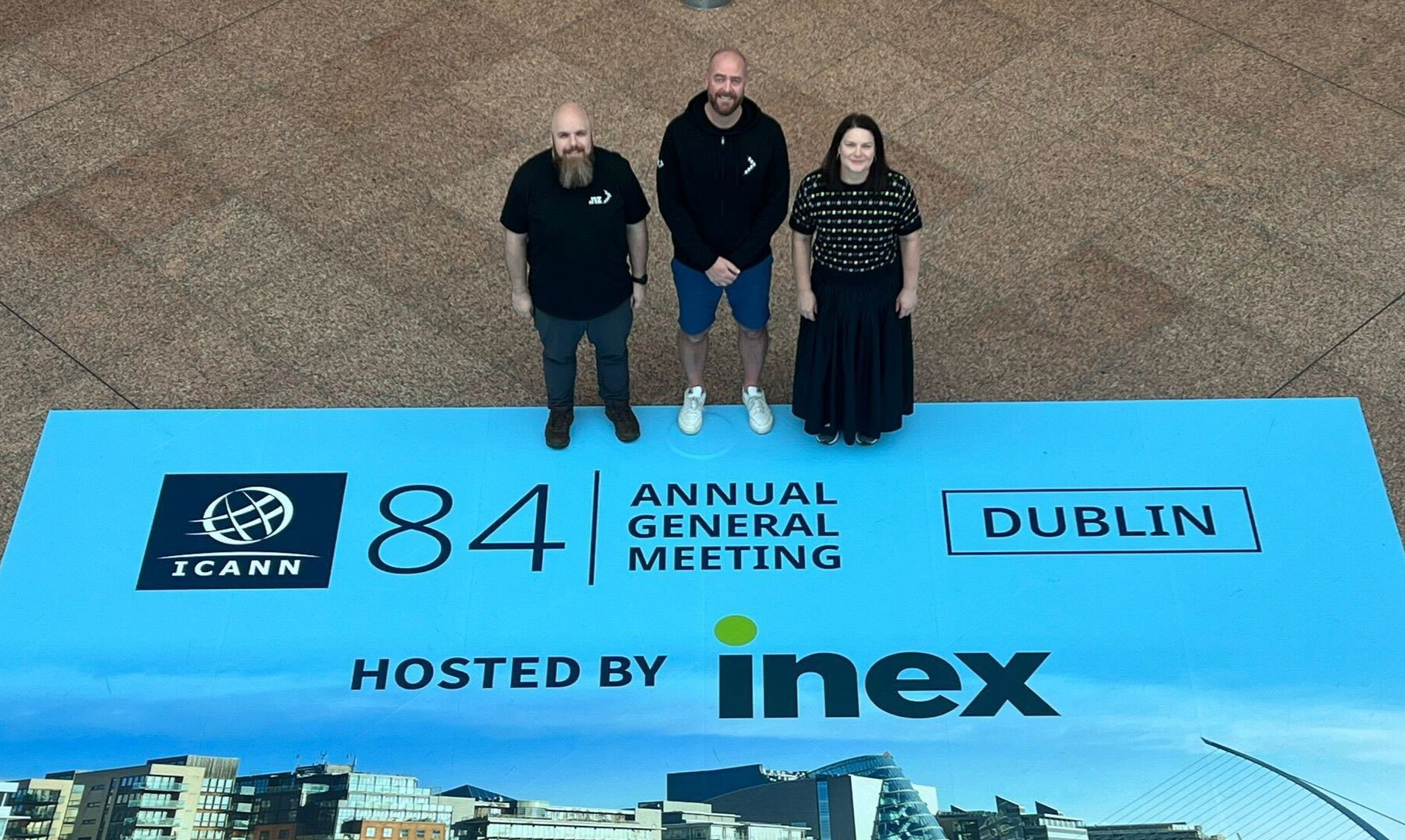
Product Infrastructure Lead Josh Simpson (left) with colleagues Tim Johnson and Jodi Anderson at ICANN84 in Dublin, Ireland.
As Product Infrastructure Lead at InternetNZ, my job is to focus on the ongoing innovation and evolution of .nz infrastructure, with a focus on the future state of the Internet and how we deliver in this changing landscape.
We’re a small team with a big job, solely responsible for keeping .nz online and alone in what we do here – so building relationships with those that do the same work in other countries is hugely valuable.
Last month, en route to OARC 45 in Stockholm and ICANN84 in Dublin, Ireland, I visited three of our international peer organisations in Sweden, Norway and Ireland. These are the organisations that, like InternetNZ, are responsible for managing the country code top-level domain (ccTLD) – .se, .no and .ie respectively.
While the way they operate may differ in many ways, connecting with other ccTLD managers gives us the opportunity to learn and improve our offerings and workings, as well as share our experiences, challenges and solutions.
Same same, but different
The Swedish Internet Foundation operates .se – at roughly twice our size, they have the benefit of scale, with multiple teams for its operations and in-house platform development as well as a separate DNS team. They operate a hybrid approach to infrastructure that we could learn from, in understanding the decisions they have made and how they could apply to .nz in possible future scenarios.
Over the border in Norway, the ccTLD manager for .no, Norid, has a small dedicated team tackling the exact problems we are likely to face in the next three years. They have a narrower focus than us but similar numbers, so we can learn a lot from what they have already and are planning to do in the coming year.
In Ireland, .ie have near identical deployment of hardware and technology concepts as us, including operating the Hello Registry platform as we do – they are facing very similar challenges as us at .nz.
Challenges ahead
There are two challenges being tackled in the EU of particular interest to us right now, both broadly related to cybersecurity.
First, all the operators I visited are subject to EU regulation, which provides some benefits – but also some challenges that influence their work.
The NIS2 Directive, which will establish a unified legal framework to uphold cybersecurity across the EU and require member states to define national cybersecurity strategies, is a hot topic for them all at the moment.
We are monitoring this with interest, as it may influence the policy approach New Zealand takes and may influence our future requirements and direction.
The second, is a more technical but fundamental issue – replacement of our DNSSEC systems. DNSSEC, in short, is a technology that uses a chain of digital signatures to prevent tampering, so it’s important to get it right.
The operators of .se have recently migrated away from the technology we use to deploy our registry and DNSSEC systems to something smaller, faster and better suited to modern operational practices. At InternetNZ we are keen to do the same, as are the team at .ie, though we have some challenges in ensuring this works within our existing architecture. So we’ll both be watching their progress and learnings closely.
Connections are key
There is only one ccTLD per country, so peer organisations are all international and they come in many shapes and sizes. But building relationships, and sharing challenges and experiences, with those that operate with similar infrastructure requirements as well as operational and organisational philosophies is our chance to establish relationships that can hopefully enrich both sides.