Stories from Te Tairāwhiti: Kaumātua confidence and a new digital lens
Over the past year, we’ve had the privilege of walking alongside Tāiki E! Impact House and the Te Tairāwhiti Digital Equity Collective, a network of organisations working together to strengthen digital confidence, access, and opportunity across the rohe.
As we wrap up the final stages of this series, we’re showcasing two additional kaupapa that show the breadth and depth of digital equity in the region: the Alexa workshops for kaumātua and The Collective’s emerging ecosystem mapping tool.
One kaupapa is practical and hands-on, bringing joy, safety, and security, into people’s homes. The other is strategic, long-term, and values-driven. Together, they illustrate the many layers of what digital equity can look like in Te Tairāwhiti.
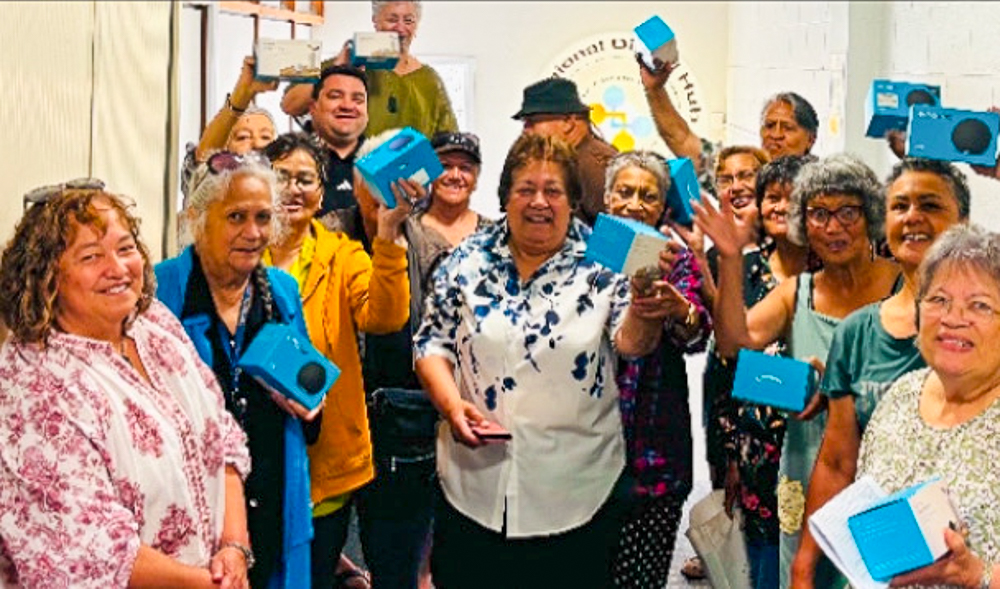
Te Tairāwhiti Technology Trust organiser, Polly Crawford (centre, blue and white blouse) with another happy cohort of kaumātua proudly holding their new smart devices after completing the Alexa confidence-building workshop.
The Alexa workshops for kaumātua
Led by Te Tairāwhiti Technology Trust
Across Te Tairāwhiti, kaumātua have been gathering for hands-on learning with Alexa smart home devices. They are discovering how simple voice commands can help with everything from safety and music to reminders, and staying connected with whānau.
Delivered across multiple communities, the four-part workshop series reached 67 kaumātua, each of whom received an Alexa device and smart bulbs or plugs to take home. Guided by patient, kanohi-ki-te-kanohi (face-to-face) teaching, participants explored everyday uses such as:
-
playing morning waiata
-
turning the lights on for security
-
setting medication reminders
-
checking the weather
-
asking for information or karakia
-
connecting with whānau
The workshops concluded with a vibrant graduation celebration, where more than 40 participants gathered to share kai, stories, and a sense of achievement.
For many, the change has been tangible:
“My house used to be quiet in the mornings. Since having Alexa, I start my day with music — the house feels alive.”
“I feel safer now. If I’m unsure, I ask Alexa to turn on the outside light.”
“I use Alexa for reminders now. It helps me stay organised.”
The project also revealed a key insight: a small number of kaumātua struggled with setup at home, highlighting the need for local troubleshooting support to be built into future programmes. This feedback has already sparked ideas for follow-on workshops, including training with AirTags to help kaumātua to locate lost keys or phones — a regular challenge noted by participants.
As Operations Manager, Polly Crawford shared, “It’s not about perfection. It’s about dignity, about connection, and about confidence.”
This kaupapa reflects what The Collective already knows: when technology is introduced in a relational, supportive environment, people flourish.
Mapping the digital ecosystem
Led by Te Weu Research on behalf of The Collective
Alongside practical projects like the Alexa workshops, The Collective has also been investing in strategic, long-term mahi to gain a clearer understanding of the region’s digital landscape.
This work has taken shape through the development of a kaupapa Māori-aligned ecosystem mapping tool, designed to provide The Collective — and eventually the wider community — with a clearer understanding of what exists, where capabilities lie, and how organisations can better support one another.
This is not a conventional “map” or a database. It is a ground-up process of defining success, built first on robust conversations about values, aspirations, and what a thriving digital equity ecosystem should look like in Te Tairāwhiti.
Some key elements of the tool:
-
A values-first framework — The Collective began by articulating what success looks like — not in terms of gaps, but in terms of vibrancy, capability, and contribution. The intention was to avoid deficit framing and instead highlight what already exists across the rohe (region).
-
Simple, non-judgemental self-assessment — organisations will input their information using a traffic-light system (do a little / do a lot / primary focus), creating a clear visual of their mahi without ranking or judgement.
-
An evolving tool aligned to Matariki — Groups will update their data annually in alignment with the Matariki calendar, embedding natural cycles of reflection, action, and renewal. This will keep the data alive and relevant.
-
Built on trust, collaboration, and kaitiakitanga — the tool is deliberately designed with strict protections in place for data ownership. Each organisation controls its own information. Data is pooled only for collective insights. And nothing is shared beyond The Collective without clear boundaries and consent.
A multi-year journey (and this is only the beginning)
This tool is an early-stage prototype of a process that spans three to four years. As members gradually input data, they will begin to see:
-
where they overlap
-
where gaps exist
-
where they can share resources
-
where they can collaborate rather than compete
-
how their collective mahi forms a stronger regional system.
As Renée Raroa from Te Weu Research said during our most recent visit: “The real taonga is not the tool — it’s the shared understanding we’ve built around what each of us brings to the table.”
And as Tāiki E! co-founder Cain Kerehoma reminded us: “Technology is a tool for transformative change rooted in indigenous principles.”
This kaupapa has the potential to support other rohe in the future, but only through their own values-led process. The Collective is clear that this is not a template to be lifted, copied, or externally imposed. It is a local, place-based expression of kotahitanga (unity) in action.
Next up — part 7: Looking ahead and a region moving together
The mahi underway in Te Tairāwhiti is broad and inspiring, encompassing digital storytelling, device refurbishing, gaming innovation, JP training, cultural publishing, rangatahi design labs, and more.
There is much to celebrate, and we’ll be sharing our final blog in this series next week, which will highlight the many remaining innovation pathways supported through the Collective’s digital equity movement and supported by funding from InternetNZ.
InternetNZ funding
These projects and partnerships are made possible through funding from our community grants programme, supported by revenue from the sale of .nz domain names. When you choose a .nz for your website, you’re helping fund initiatives like these, supporting digital equity and innovation across Aotearoa.