Stories from Te Tairāwhiti: a region moving forward together
We’ve spent the last few months sharing stories from across Te Tairāwhiti, each one showing what becomes possible when communities are trusted, resourced, and supported to shape their own digital futures. We’ve highlighted the teams igniting tamariki interest in STEMM, the Alexa workshops helping kaumātua stay connected in an ever-changing digital world, the innovation hub that’s become a lifeline for an isolated East Coast community, and the mahi of educators, entrepreneurs, researchers, and local leaders who are driving change in their own backyards.
Together, these stories reveal something important: Te Tairāwhiti isn’t waiting for solutions to arrive. The community is building them from the ground up.
Concluding this seven-part series for 2025, our focus now shifts to three smaller, yet equally vital, initiatives across the region. These modest-sized projects, supported by InternetNZ funding, are instrumental in sparking innovation, building local capacity, and bolstering digital confidence. Each one signifies a community taking the initiative, pioneering new ideas, and establishing pathways for others to emulate.
These innovation grantees — and others — are actively shaping the digital future of Te Tairāwhiti. Our team was fortunate to hear their stories of success at a Digital Innovation Showcase, hosted at Tāiki E! Impact House. Here is a snapshot of those presentations:
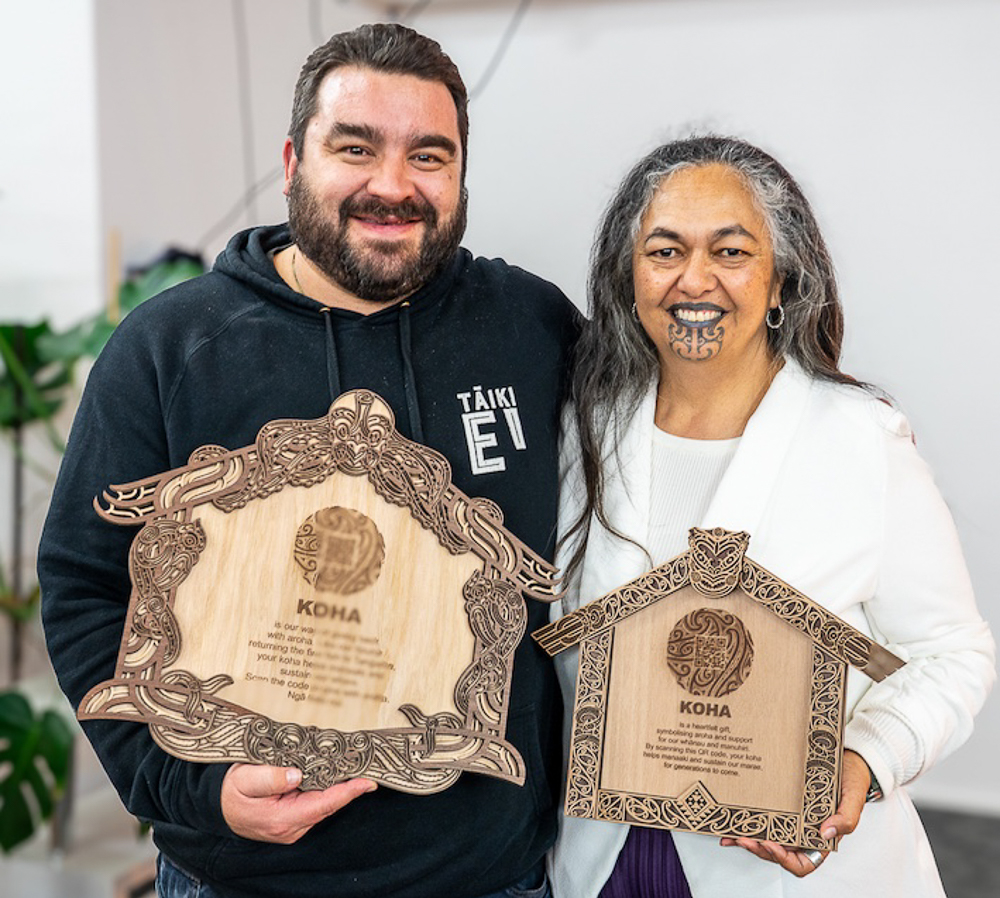
Tāiki E! Impact House founder, Cain Kerehoma, with Ani Pahuru-Huriwai of Wharekahika Hicks Bay, proudly showcasing the i-koha signage for Hinemaurea marae.
Solving the old koha haka dance
“Aunty” Ani Pahuru-Huriwai arrived halfway through the showcase, sweeping in with beautiful “kia mānawanui, whānau” energy — late because she’d been at another hui “just down the road.” She introduced herself simply: “I’m Aunty Ani, from Wharekahika Hicks Bay,” and then got straight to the heart of it.
“Our kaupapa is called i-koha — a solution for something really simple but really annoying: koha on the marae.” She explained: “No ATMs. Shops running out of cash. Manuhiri doing the haka, looking for their wallets or an EFTPOS machine.”
“It's embarrassing for them,” she said. “And awkward for us when they can’t give koha.”
Then there was the other side of the problem — people handing her random notes and coins to bank on their behalf.
“But I’m not even with the same bank as the marae,” she laughed. “So then I can’t deposit it. You can imagine the mess that creates.”
So the whānau at Hinemaurea marae started dreaming up something easier. That something easier needed to keep tikanga intact while removing all the admin that no one wants.
Their first prototype was simple, elegant, and intentional: a beautifully designed QR code sign (shout-out to the Tāiki ē crew) that links directly to the marae bank account. Hang it at the gate, on the wharenui, by the ātea (open area in front of the wharenui where formal welcomes to visitors take place, and issues are debated) — and if you’ve forgotten cash, you can still do what you came to do: give koha, properly.
Ani gestured to the sign next to her.
“This is what we’ve designed. We didn’t want laminated printouts stuck everywhere. We wanted something with mana — something that feels like it belongs on our marae.”
But she wasn’t done. The next phase is even more imaginative: a tap-and-go koha point built into a natural feature of the marae — perhaps a rock on the ātea.
“Imagine the kaikōrero [speaker] standing and saying, ‘Tēnei taku koha [this is my koha],’ and just tapping the rock. And boom — it’s done. Manaakitanga [generosity, support], preserved.”
It’s such a small idea on the surface, but Ani reminded us how powerful it could be for marae across the motu who are grappling with the same practical realities.
Cain Kerehoma, Tāiki E facilitator and manager, described i-koha as a perfect blend of tikanga and tech — evolving a practice without losing its heart. They even trialled it at Hauiti Marae: “After the mihi, I pulled out my phone and said, ‘My koha is in. Wi-Fi’s good’. Our marae are ready.”

CAPTION Eremoana Hobson speaks at the Digital Innovation Showcase, sharing all about Project Kura Kai, a project focused on digitising marae kai knowledge for future generations.
Marae kai for 100? There’s a folder for that!
Eremoana Hobson presented on behalf of the Tolaga Bay Inn Heritage Trust to share Project Kura Kai — a project focused on digitising marae kai knowledge so it can be preserved, shared, and passed to future generations.
The idea was simple: gather all the whānau know-how about planning, cooking, and running large-scale hui kai, and make it available online in a way that anyone can use. They created a Google Drive filled with seasonal kai guides, planning tools, and recipes designed for feeding anywhere from six people to a full marae of 100. Each recipe comes with budgeting tables, nutritional information, and automatic portion adjustments — practical, no-fuss resources developed from real costs and real-life events.
The design is intentionally clean and rustic, utilising Canva templates and simple branding to maintain readability and a welcoming atmosphere. And yes, Eremoana laughed, they used ChatGPT to tidy up the writing.
“When I write a recipe, it makes sense to me, but maybe not to someone else,” she said. AI helped with clearer wording, scaling conversions, nutrition details, and formatting. There was even a moment where they realised the coloured highlights on screen were just the AI showing how it interpreted their prompts — a tiny win in the learning journey.
To bring it all to life, they’ve started making short, TikTok-style videos to accompany each recipe, so people can watch how to prepare kai while they’re cooking.
Showcase facilitator, Cain Kerehoma from Tāiki E! summed it up well: “Honestly, seeing this kaupapa grow has been such a highlight. This is knowledge that’s usually locked in the heads of one or two aunties at the marae — and if they’re not there, no one knows what to do. But now we’ve got a beautiful, accessible archive — and it’s our rangatahi leading that transformation."
"Tech isn’t replacing our tikanga; it’s helping us pass it down."
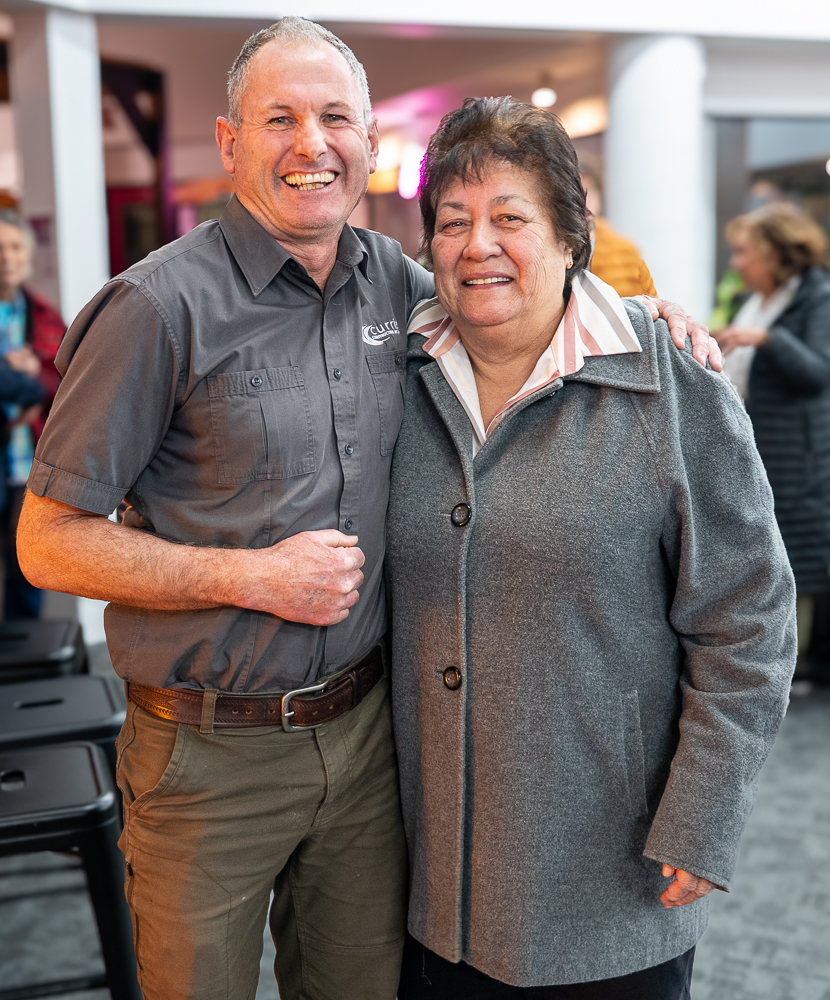
CAPTION Mark van Wijk and Polly Crawford, long-serving Te Tairāwhiti JPs, are adapting their mahi and supporting their fellow JPs, to meet the needs of a digital era.
Helping our JPs navigate the digital era
In a world that has shifted almost entirely online, even the most traditional community roles are being transformed by digital technology. Mark van Wijk, one of Gisborne’s long-serving Justices of the Peace (JPs), put it plainly: “Everything is digital now. When someone comes to us to certify a document, half the time it’s their nursing registration on their phone — not a printed certificate, not a hard copy.”
Navigating emails, attachments, and cloud storage has become part of the job. And while some JPs have adapted quickly, others — particularly the more mature JPs who have been serving their communities for decades — are grappling with the pace of change. “To do our job properly, we need to verify that what we’re seeing is legitimate,” Mark explained. “For our older JPs, that’s a real challenge.”
And all of this happens in a role that is entirely voluntary.
“We don’t get paid,” Mark explained. “Most of us actually pay an annual fee to stay registered.” So when their shared laptop died late last year, the impact was immediate: no device, no way to support the steady stream of community members needing documents certified.
A chance conversation at a collective hui changed that trajectory. Mark shared their situation, and before the kōrero had even wrapped, Shannon (from Tōnui Collab) had quietly stepped in. “Hey, I think we can help,” she said. “We’ve got some recycled laptops that we can actually gift to you.” Within weeks, refurbished laptops were delivered — a simple intervention that unlocked a huge amount of community service.
With the new devices, Mark and fellow JP, Polly Crawford, hosted a JP hui at the library — 25 to 30 people gathered to help each other catch up on the digital side of the role: electronic documents, email verification, cloud sharing, “all that jazz,” as Mark put it with a grin.
They also identified another gap: the need for JP stamps to certify electronic documents. “Each stamp costs around $100,” Mark said, “so we’re using part of our pūtea [money] to provide them for some of the Coast-based JPs who don’t have those resources.”
The reason is simple and heartfelt.
“Our pakeke [mature] JPs — some are 75, 80 — are still doing incredible mahi for their communities. We just want to help them keep doing it, with the right tools.”
It’s the quiet kind of community support most people never see, though almost everyone benefits from it at some point. As Mark reminded us: “Chances are, one of you has needed something signed by a JP. That’s us. We’re just trying to do our bit behind the scenes to keep the wheels turning.”
A small investment in tech, a bit of digital upskilling, and a whole lot of manaaki — that’s what’s keeping this backbone of their community steady as the world moves online.
Haere rā 2025, hāere mai 2026!
The future of digital equity in Te Tairāwhiti isn’t being built in one place or by one organisation. Here, it's being woven by many hands — marae, schools, creators, researchers, rangatahi, and community-led groups who know their people best.
This series has only scratched the surface of the creativity and determination that exist across the rohe. However, one thing is clear: Te Tairāwhiti is charting its own path, developing digital solutions that reflect its people, culture, and vision for the future. And we’re proud to support that journey
We’ll be bringing Stories from Te Tairāwhiti back in January, 2026, when we return to check in on several other kaupapa we’ve funded and are excited to follow — including the HF email radio server keeping remote communities connected, the Te Tairāwhiti Environment Centre’s digital initiatives, the writer’s hui and e-book publishing project, and the ongoing literacy mahi supported through Literacy Aotearoa.
We’re also looking forward to featuring new community projects from across Aotearoa — fresh ideas, local innovators, and initiatives that deserve to be seen and celebrated. Our series might be wrapping for now, but the stories aren’t stopping. We’ll see you again in 2026 — there’s plenty more to share.
InternetNZ funding
These projects and partnerships are made possible through funding from our community grants programme, supported by revenue from the sale of .nz domain names. When you choose a .nz for your website, you’re helping fund initiatives like these, supporting digital equity and innovation across Aotearoa.